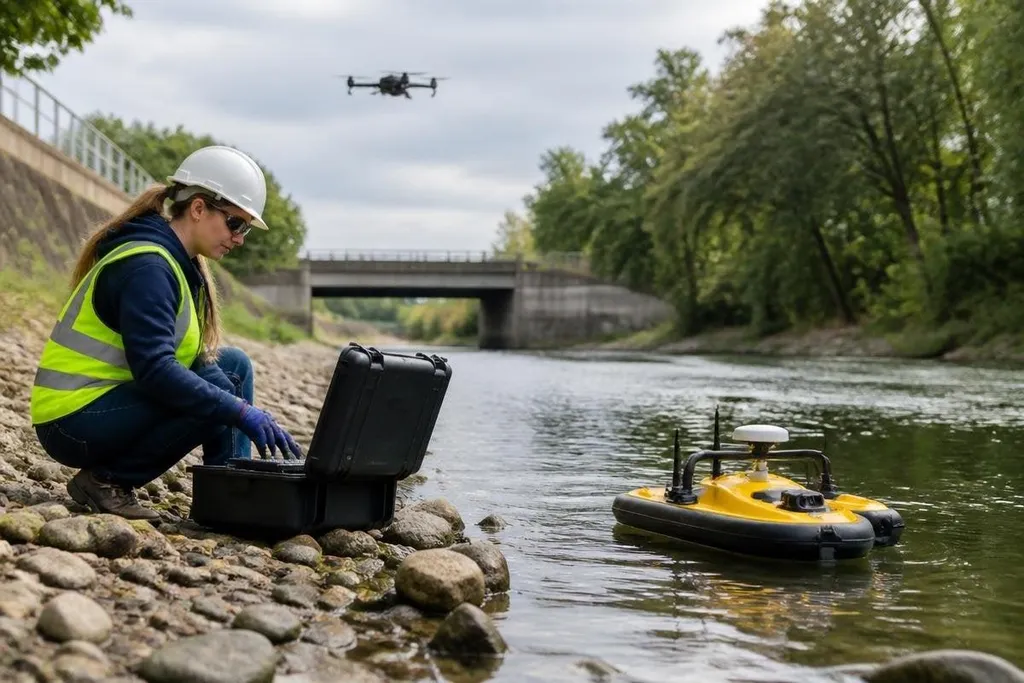
Environmental robots work where people face dirty water, unstable ground, toxic waste, or long hours outside. The biggest changes will come from machines that can sense a site, act on what they find, and leave a record that people can check.
For an industry reader, the useful question is not which robot looks most advanced. It is which task can run safely, with enough evidence to justify its cost.
Quick read
- Water robots can check places that are hard or unsafe for crews to reach.
- Farm robots need careful control around plants, soil, and people.
- Cleanup machines face the hardest test: mixed waste, poor visibility, and changing ground.
Robots that inspect water
Small surface boats and underwater robots can carry cameras, sonar, water sensors, or sample tools. Their value comes from collecting repeatable readings across a site without sending a person into every area.
The hard part is knowing where the robot is. GPS can help at the surface, but it does not work underwater. An underwater system may need an inertial sensor, sonar, and a map made from earlier passes. Each tool adds data, weight, power use, and another possible failure.
A useful system will show more than a colored map. It should link each reading to a time and position, flag gaps in the route, and let a technician review the raw data.
That record matters when a site owner must decide where to sample again or send a crew.
Mud and uneven ground change the test before a farm robot reaches a crop row. Robot24.com reports on field robotics can name the machine, route, sensor, test date, and measured result, giving you a way to judge whether a trial fits farm or forest work.
Machines for farms and forests
Outdoor robots have to deal with loose soil, roots, slopes, dust, rain, and changing light. A robot that follows a fixed path in a clean test area may need a very different design on a working farm or forest floor.
Plant care is a good test of useful autonomy. A robot may need to tell a crop from a weed, move close to the ground, and apply treatment to a small target without touching nearby plants. That calls for cameras, careful motion control, and an end effector, meaning the tool at the end of the arm.
Forest machines face another problem. Trees block signals, the ground changes under the wheels, and a site can contain branches that look like obstacles but move when touched. Progress here will show up in fewer remote interventions and cleaner site records, not in a short video of one successful run.
Cleanup is where claims meet hard conditions
Waste sites are difficult because the objects vary in size, shape, weight, and material. A gripper that picks one known item from a fixed bin has a smaller job than a robot sorting mixed debris after a storm.
The robot must identify the object, choose a safe grip, move it without dropping it, and decide what to do when the item does not match its training data. Dust can block cameras. Water can affect electronics. Uneven ground can change the arm’s reach.
Human control will remain part of many systems for a while. Teleoperation lets a person handle an unusual object while the robot records the action. That record can later help engineers improve the robot’s control system, though nobody has shown that every cleanup task can run without help.
What counts as progress
A field robot earns its place when the full task works repeatedly. A single successful pickup or inspection pass says little about repair time, battery charging, weather limits, or safety stops.
Use this checklist when you assess an environmental robot or a pilot project:
- Name the task: write down the exact job, material, area, and expected result.
- Check the route: ask how the robot handles blocked paths, poor signals, slopes, and water.
- Review the record: confirm that images, sensor readings, locations, and operator actions are saved.
- Count human input: measure how often a person must take control or reset the system.
- Price the whole job: include transport, charging, maintenance, data review, and staff time.
I'd watch the data record more closely than the robot’s shape. A machine that leaves a useful, repeatable record can improve a worksite even before it handles the hardest task alone.
The next test is simple to state and hard to fake: can the robot repeat the same environmental job across a full site, through changing conditions, with its limits recorded?